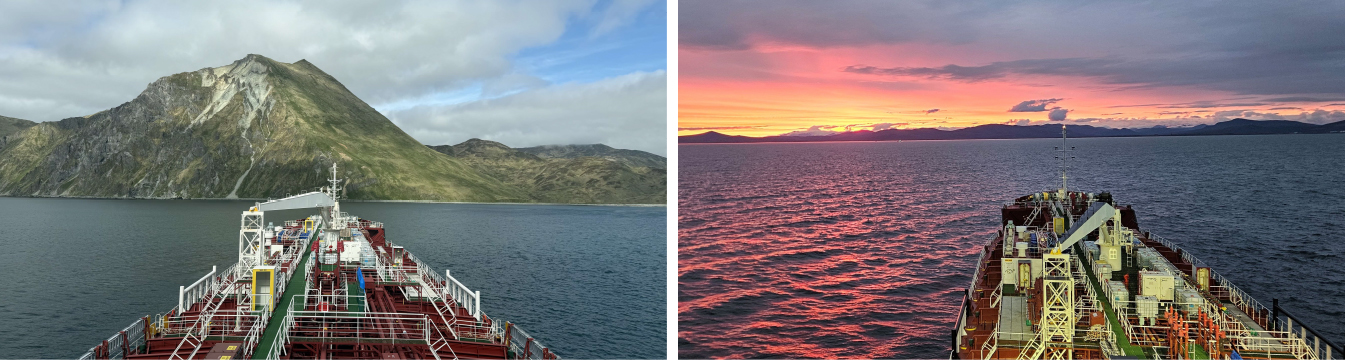
During a voyage to Nome, Alaska, the crew of MT Ebisu experienced polar navigation under the Arctic summer’s midnight sun, combining safe operations with memorable encounters across one of the world’s most distinctive maritime environments.
The vessel, a chemical tanker owned by Union Maritime, navigated high-latitude waters where professional seamanship, careful planning and environmental awareness all played an important role.
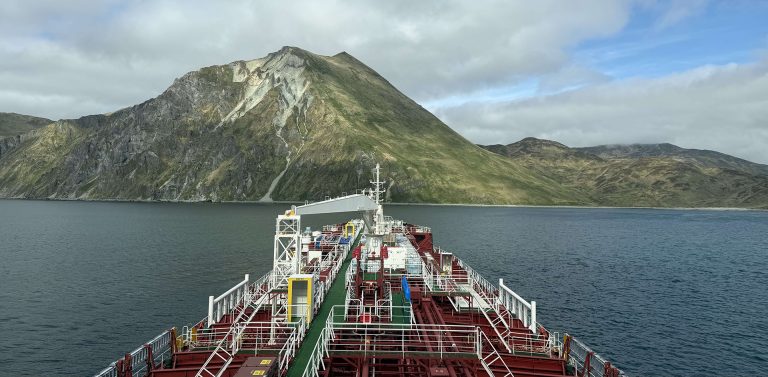
As MT Ebisu approached the Alaskan coastline, the crew encountered the phenomenon of the midnight sun. Near Nome, darkness never fully arrived, with the sun dipping only briefly below the horizon before rising again. For the crew, the continuous daylight supported navigation, lookout duties and deck operations, while also giving routine watches an unusual and memorable backdrop.
Navigating Arctic waters
Operational conditions remained largely favourable throughout the voyage. Air temperatures ranged between 5°C and 20°C, while sea temperatures remained between 4°C and 12°C, creating comfortable working conditions for the crew. No sea ice or icebergs were encountered during the passage or while anchored off Nome. Ice information from US National Oceanic and Atmospheric Administration (NOAA) reports proved reliable and supported voyage planning and navigational decision-making.
Even with favourable weather and no ice, Arctic navigation required constant attention. Dense patches of advection fog occasionally developed with little warning, reducing visibility and requiring heightened bridge watchkeeping. Radar and AIS (Automatic Identification System) monitoring, together with strict adherence to COLREG (International Regulations for Preventing Collisions at Sea) requirements, supported safe navigation in restricted visibility. Strong tidal streams, wind-driven currents, floating logs and the potential presence of growlers reinforced the need for vigilant lookouts and careful route monitoring.
Encountering Arctic wildlife
The voyage offered striking views of the Alaskan coast. Vast stretches of tundra, rugged cliffs, rocky shorelines and rolling hills framed the route, while calm Arctic waters reflected changing shades of blue across the sky and sea. Each watch from the bridge brought a different view of the remote landscape and reinforced the scale and natural beauty of the region.
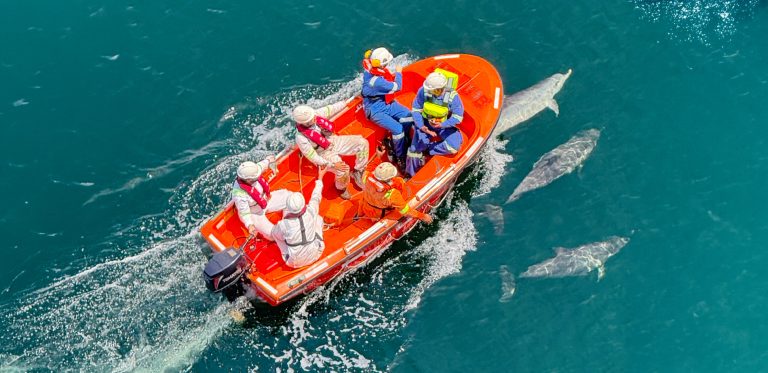
For many on board, the wildlife was among the most memorable parts of the voyage. Whales were frequently sighted near the vessel, while seals and seabirds were also seen in the surrounding waters. These encounters were a reminder of the ecological significance of the Arctic region and the responsibility that comes with operating in such a sensitive environment.
Safe anchoring off Nome
MT Ebisu anchored safely off Nome, where favourable holding ground supported the operation. Navigational and communication equipment, including GPS, gyro compass, magnetic compass, radar, AIS and HF (High Frequency) communication systems, performed reliably throughout. Although MT Ebisu is not an ice-class vessel, she was equipped to operate in line with Polar Code requirements, with a GNSS (Global Navigation Satellite System) compass, remote-controlled searchlights and emergency Aero VHF (Very High Frequency) radio for aircraft communications.
The voyage showed that summer navigation in Alaskan polar waters can be carried out safely when supported by reliable environmental information, effective communications, sound equipment and strong bridge resource management. For the crew, it also offered valuable practical experience in high-latitude navigation, anchoring, environmental awareness and traffic management, turning a routine trading voyage into one they will remember for years to come.
If you are interested in knowing more about our services and offerings, including but not limited to ship management, crew management, newbuilding services, and innovative projects on board our managed fleet, feel free to contact us.