A widely cited figure in maritime human resources is a projected shortfall of around 39,000 additional officers. The issue facing shipowners and operators today is not solely crew availability. Crewing has become directly linked to safety performance, financing access and a vessel’s ability to remain in continuous operation.
The underlying drivers are structural. Seafarer expectations have shifted, shaped by the crew-change crisis during the pandemic and by a younger workforce placing greater weight on connectivity and welfare standards. At the same time, the lack of structured career progression plans is affecting retention and weakening the pipeline of future officers.
Financial stakeholders are responding to the phenomenon – lenders and charterers are increasingly assessing welfare standards and crew stability as part of broader environmental, social and governance considerations. What was previously treated as an internal operational matter is now visible externally and carries more commercial implications.
Under-crewed is under-protected
The link owners cannot afford to ignore is the one between crewing and safety. A vessel that is under-crewed, over-worked or staffed by people who would rather be elsewhere is, by statistics and common sense alike, a higher-risk vessel. Fatigue degrades judgement, and the great majority of incidents trace back to human factors. High turnover erodes the familiarity that keeps a ship running smoothly and safely. Poor morale shows up, eventually, in incidents, claims and off-hire. Running lean looks attractive on a spreadsheet and considerably less so after a casualty.
“Crewing and safety are not two separate conversations; they are closely interconnected,” says Vinay Singh, Group Managing Director of Marine HR at Anglo-Eastern. “A ship that is properly crewed, properly trained and properly supported doesn’t just perform better on paper. It is measurably safer, and that’s the standard we hold ourselves to across every vessel we manage.”
A further twist is specific to this decade. The fuel and technology transition is raising the skills bar at the very moment the labour pool is tightest. The same officer market now has to supply people competent in ammonia handling, methanol bunkering and shipboard cyber-awareness. An owner is therefore not just competing for crew, but for crew upskilled for the ships the industry is actually building.
The age profile adds another dimension. The average age of officers at management and operational levels has been rising steadily. Today, fewer than 25 per cent of seafarers plan to spend their entire career at sea, with many seeking shore-based roles within 15 years.
Promotions and certifications are occurring later in life, delayed by career breaks and retraining. That trend carries real operational implications: an ageing management layer slows the pipeline and narrows the pool of officers ready to step up.
Seen this way, crewing is squarely a risk-management question. The owners most exposed in the coming years will be those treating crew as an interchangeable cost line. The most resilient will be those who have secured reliable access to a deep, well-trained and well-supported pool of people — including the relief and surge capacity to cover a sudden crew change in a difficult port — and who can demonstrate that resilience to charterers, regulators and financiers.
Our approach: supplying talent with a sustainable pipeline
Crewing is the part of our business closest to who we are. Nurturing our people and communities is the first of our values, and it is not a phrase we apply selectively. It is the foundation of how we manage ships.
We care for the 39,000+ seafarers recruited from more than 65 countries, and we train our own. Across wholly-owned establishments in Asia and Europe — including our flagship Anglo-Eastern Maritime Academy in Karjat, an award-winning, DNV-certified pre-sea institution — we bring through hundreds of cadets each year, feeding a pipeline rather than depending on a spot market. Around 30,000 seafarers go through enhancement training annually across our in-house training centres. The result we are most quietly proud of is a seafarer retention rate above 95 per cent. In an industry wrestling with attrition, people choosing to stay with us is the clearest evidence that the welfare commitment is real and not merely stated.
We have also confronted the age-profile problem directly. Mission 30 — launched in 2025 — is a structured initiative to elevate at least 30 percent of our seafarers under the age of 30 to the management-level officers (Captain, Chief Officer, Chief Engineer, Second Engineer) by 2030, through structured career pathways, personalised mentoring and targeted training. More than 5,000 operational-level officers and cadets have been contacted to enrol. Since the Career Care team was formed in 2024, the number of junior officers sitting competency exams has risen 20 per cent, and the rate of internal promotions is up 11 per cent. These are not headline numbers; they are indicators of a pipeline that is genuinely moving.
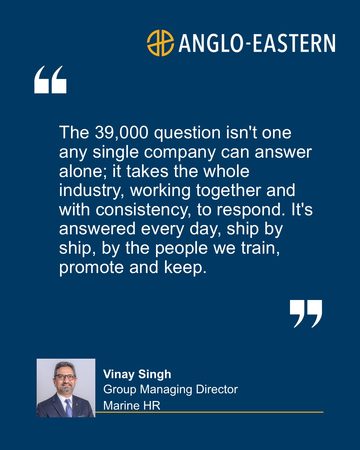
“The 39,000 question isn’t one any single company can answer alone; it takes the whole industry, working together and with consistency, to respond” notes Vinay Singh, “It’s answered every day, ship by ship, by the people we train, promote and keep.”
The architecture behind Mission 30 reflects how seriously we take career development as a retention and risk-management tool. Every officer has a personalised career ladder map, accessible through our WE Care app, showing the steps required to progress and the resources available to get there. The Career Care programme is built on three pillars — clarity, consistency and support — with a dedicated team of experienced Marine HR leaders providing individual guidance on certification, rank transitions and long-term planning. The STAR Awards recognise officers who demonstrate drive and initiative, and a mentorship programme pairs newly promoted management-level officers with experienced Masters and Chief Engineers.
For an owner, that pipeline is not an abstraction. It is access to crews who are properly trained, properly supported and likely to remain — which is to say access to lower operational risk and a story you can tell with confidence to your charterers and your bank. The 39,000 question will not be answered by any single company. It can be answered, ship by ship, by choosing to crew through an organisation that treats seafarers as the heart of the enterprise rather than a variable to be minimised. Driving performance, in our experience, begins with the people who deliver it.
If you are interested in knowing more about our services and offerings, including but not limited to ship management, crew management, newbuilding services, and innovative projects onboard our managed fleet, feel free to contact us.